


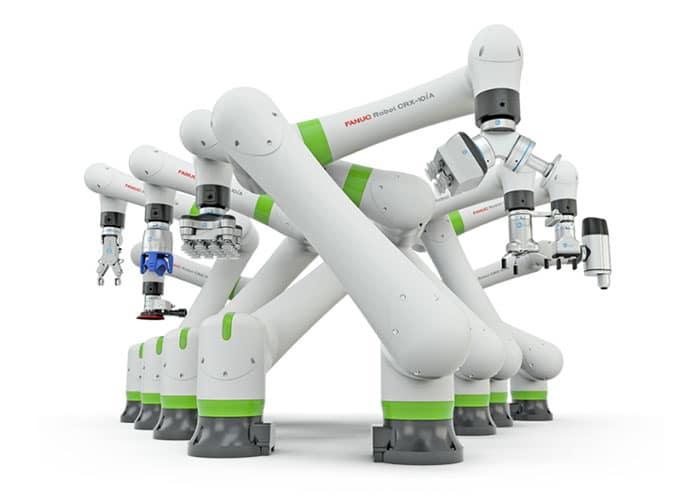
 ROBOTICS
  SEMICONDUCTOR (MSW KOREA)
  CRYSTAL SENSOR (QCM)
  LEAD SOLDERING
  SOLDERING MACHINE (METCAL)
  SPOT WELDING (UNION)
  IONIZER BLOWER (CORE INSIGHT)
  SPRING BALANCER (TIGON)
  TIG+LASER WELDING (NICHIA)
  MRO
MRO On the morning of January 16, Viettel held a groundbreaking ceremony for the semiconductor chip manufacturing factory project in Hoa Lac Hi-Tech Park, on an area of 27 hectares, to celebrate the XIV National Party Congress.

General Secretary To Lam and Prime Minister Pham Minh Chinh attended the groundbreaking ceremony of the first semiconductor chip manufacturing factory in Vietnam. Photo: VGP
At the groundbreaking ceremony, Lieutenant General Cao Duc Thang, Chairman and General Director of Viettel, said that the Group will start implementing the project immediately after the event.
"The goal is to complete construction investment by the end of 2027, receive technology transfer and start trial production," he said. In the period from 2028 to 2030, the group plans to complete and optimize processes, improve line performance according to industry standards, thereby serving as a basis for researching chip manufacturing technology in a more modern process.
Viettel's representative affirmed that this is an important milestone, the first time that Vietnam has formed the capacity to manufacture semiconductor chips domestically, creating a foundation for the goal of gradually mastering core technology and sustainably developing the digital economy.
The project is oriented to become a national infrastructure for research, design, testing and production of semiconductor chips. When put into operation, the factory can meet the needs of national industries such as aerospace, telecommunications, Internet of Things (IoT), automobile manufacturing, medical equipment, automation, etc.
Previously, Viettel also designed 5G chips, prepared human resources through intensive training, international cooperation and technology transfer, and accumulated experience from research, design and application of chips in technology systems and products.

Photo of Viettel chip manufacturing factory. Photo: Viettel
At the event, Prime Minister Pham Minh Chinh emphasized that the start of the chip factory shows that Vietnam can completely master high technology step by step. "This helps complete an important link in the global semiconductor value chain, marking the transformation from participation to ownership, from assembly to innovation, contributing to improving Vietnam's potential and position in the digital era," said the Prime Minister.
The factory is also expected to become a practical training center for semiconductor human resources, linking training with the actual production environment. Through this, Vietnam aims to train 50,000 chip design engineers in the Semiconductor Industry Human Resource Development Program by 2030, aiming for the size of Vietnam's semiconductor industry human resources to reach over 100,000 people in the National Semiconductor Strategy to 2040.
The construction of the factory is expected to help complete and close the entire semiconductor chip production process right in Vietnam.
A complete semiconductor chip product must go through the main stages including: product definition, system design, detailed design, chip fabrication, packaging - measurement and testing and integration - testing. Vietnam has gradually participated in 5 stages; Particularly, the chip manufacturing stage is considered the key stage, but the most complicated and cannot be carried out in the country. Many domestic enterprises have been able to carry out the design, but when it comes to production, it is still necessary to order from foreign factories.
Chip manufacturing requires the most sophisticated and disciplined technological processes today. From a silicon wafer of near-absolute purity, the chip is formed through about 1,000 successive technological steps, lasting for three months. Just a small deviation at any stage can affect the entire line, requiring a high level of organizational capacity, management and technology mastery.
Therefore, most of the chip manufacturing globally currently relies on a few big names with decades of experience such as TSMC (Taiwan Island), GlobalFoundries, Intel (USA), Samsung (South Korea), SMIC (China)...
At the event, the Prime Minister assessed that the semiconductor industry is not purely an economic sector, but has become a geopolitical and national security issue, as well as a symbol of the technological power of each country. Any country that lacks capacity in the semiconductor industry will be limited in its capacity to develop its strategic autonomy, develop its economy and ensure national security.
"Vietnam is not on the sidelines and there is no easy job. We choose a difficult but sustainable path: Step by step mastering core technology, actively participating in the global supply chain, on the basis of equal and mutually beneficial cooperation," said the Prime Minister.
Luu Quy